Tuesday, January 1, 2013

Chick Flicks

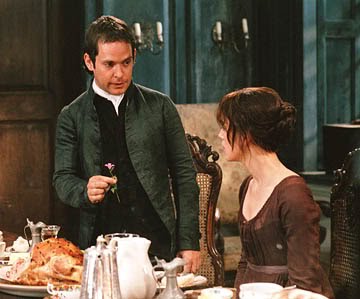
Goodness, I dislike chick flicks! You know why? Because they make me want a boyfriend. Really bad.  They make me want someone to hold hands with, someone to snuggle with, someone to kiss passionately in the pouring rain - because for some reason when he's soaking wet and looks like a dog he's more attractive, and its more romantic, or something like that.

("But I have nothing. My hands are empty." "I can fill them.")


But I don't want a boyfriend, and I am not going to have a boyfriend, and I'm not ready to be courted yet, so I'm just going to have to wait.  But they make me not want to wait!

So why do I keep watching them, you ask? BECAUSE THEY'RE SO CUTE!

("Sabrina, where have you been all my life?" "Right over your garage.")


 And I can relate to them, because I'm a girl, and that's why they're chick flicks. And the Guys they fall in love with are so amazing, and so handsome, and so everything I want in a husband - well, not a husband, but a boyfriend (but I don't want a boy friend, remember?)

("Miss Elizabeth. I have struggled in vain and I can bear it no longer. These past months have been a torment. I came to Rosings with the single object of seeing you... I had to see you. I have fought against my better judgment, my family's expectations, the inferiority of your birth by rank and circumstance. All these things I am willing to put aside and ask you to end my agony."  "I don't understand."  "I love you.") 


And I love to banter like they do in the movies, it's so much fun! But it's so not good, and it hurts people, and I have sworn it off forever.  But then I watch a chick flick...and the resolve...well...it kind of goes away...Which is not good!
Goodness, what's a girl to do?

Oh! Briliant stroke of genius!!!  JUST KISS HIM!!!!   No.  Bad plan.  That doesn't fix a thing.  No matter how tired he may be.  Trust me.

I've tried to swear them off for good, but it never seems to last longer than a month or two - and the side effects only last for a couple days, a week tops.  So maybe its not that big of a problem; maybe its a good exercise in self discipline, or something like that.

Or, I could just get married, that would fix the problem. But I don't want to get married for at least another year, and I did promise several people I'd wait at least two.  So that's out of the question, too.

(This has been my motive, my fair cousin, and I flatter myself it will not sink me in your esteem.  And now nothing remains for me but to assure you in the most animated language of the violence of my affection.)


Sparingly.  That's my conclusion.  I will only watch them sparingly.

And maybe one of these days I'll stop watching them all together.

Friday, December 28, 2012

The Universality of Principles of Art

Last week for piano I wrote a piece that I was quite excited about, I showed it to Cody (my piano teacher) and asked for critique: he said that the parts were not bad, some of them were good, but the whole thing (which was not that long to begin with) lacked a cohesiveness of sorts, it had no structure, and the parts didn't relate to each other in a natural flow; so I needed to find a way to structure it.  Then, I don't remember if it was me, or Cody, but one of us related it to a speech, and in those terms what I had was a bunch of one sentence ideas, which related to each other, but didn't naturally flow, and had no substance. They needed to be expanded into full paragraphs expounding those ideas.  And then it made sense, perfect sense!  I get writing speeches, I know how to write a good speech, and now, with a couple of examples Cody played for me from other composers, I get how to write a good song!
The more I thought about it, the more it made sense; I started thinking of all the different ways I could structure it, all the different ways I could transition from one phrase to the next (musical phrases, that is - it actually is the technical term for it) using the techniques I learned from Speech and Debate.  I thought of the Gettysburg address, and how beautifully Lincoln flows from one paragraph to the next, stating one idea, and then restating it in such a way that it transitions to the next idea, ad infinitum. Example:

Four score and seven years ago our fathers brought forth on this continent, a new nation, conceived in Liberty, and dedicated to the proposition that all men are created equal.
Now we are engaged in a great civil war, testing whether that nation, or any nation so conceived and so dedicated, can long endure. We are met on a great battle-field of that war. We have come to DEDICATE  a portion of that field, as a final resting place for those who here gave their lives that that nation might live. It is altogether fitting and proper that we should do this.
But, in a larger sense, we can not dedicate -- we can not consecrate -- we can not hallow -- this ground. The brave men, living and dead, who struggled here, have consecrated it, far above our poor power to add or detract. The world will little note, nor long remember what we say here, but it can never forget what they did here.  Etc

I did that with a speech once, it was really cool, and it turned out really well.  That same exact principle applies to music.

Also in the course of these musings came the realization of why I could never really understand Mozart and Bach's music: they weren't writing Abraham Lincoln speeches, where each idea flows into the next, there is no explicit thesis, and no "Point 1, Point 2, Point 3," That's how Chopin wrote music, that's how Grieg wrote music; that's what I kept expecting, and trying to find, but that's not how they wrote. Bach and Mozart wrote essays, where there is a very clear and defined thesis (or theme/exposition) and there are explicit "point 1, 2, and, 3, conclusion"s that don't have to flow seamlessly into each other (or variations, recapitulations, etc). But, either way, there's still a "centrality" to all the musical ideas in both cases.
Then, thought I, "Holy cow! these principles transfer so smoothly back and forth between music composition, and speech composition.  I wonder how far I can take this? What about the principles of style, do they apply to writing music, too? How do I create a metaphor (note: I am using metaphor here in a broad sense encompassing metaphor, simile, analogy, etc) with music?  Well, what is metaphor?  A metaphor in speaking is usually relating one idea or thing to another, to help your audience understand the first thing better, and giving the first thing all the attributes of the second . (i.e. If I say a lady is slobbering mad, I'm implying that she's very mad, in a way that makes her look quite idiotic, disgusting and insensible, and it's easier to understand than the explanation of the metaphor I just gave.)  
In my limited, expansive knowledge of music theory, a musical metaphor would probably be where you take a phrase, or a theme, and put it with another them, or another variation of the theme - in a sense all a word is is a metaphor for an idea, a concept, and experience, a thing, etc; and all music is is a metaphor for feelings, emotions, and ideas that aren't expressible through words.

And of course,the musings didn't stop there.  Next I wondered, what about the visual arts, like painting, and sculpting? They're very different; speaking and music both deal almost explicitly with sounds which must be experienced over time - music is composed solely of tone, volume, and rhythm/timing.  But in arts like painting and sculpting the art is experienced almost instantly, and time has very little, if anything at all, to do with the overall effect of the painting on the viewer.  Are Metaphors still possible in these arts?  Yes, they are inextricably essential.  In painting the figures, or shapes, the basic geometry of the subject is the idea, and the way the subject is position, decorated, expressed, the colors used, the background given, the lighting, the detail or lack thereof are all explaining the idea in greater depth, and relating it to other ideas. (the following are all just random pictures I got from google...)


In this picture the background colors, and the way their painted are metaphorical movement, as is the way she's positioned.  The blurriness is relating it to an almost dreamlike state, metaphorically, she's not in the world.


In this one God is reaching down to Adam.  First of all, how is that not symbolic/metaphorical? His hair is white, His robe is scarlet, He has little babies flying around Him - those are all metaphors; they are connecting a color, an attitude, a position, ideas to God to help us understand better the God the artist is portraying.

File:Statue-Augustus.jpg
Yeah, this one I'm not sure is necessarily metaphorical, but it does have other elements of style also found in speaking, i.e. allusion (the baby thing  at the bottom.  I don't know what its alluding to, though; those are usually very culturally based - mythos and all that. Allusion is used in music, too; a lot of composers drew heavily from the popular folk music of the time.)

normanrockwell

This one's self explanatory.  (So cute!)

The conclusion? Principles of art are universal - whether you're painting a picture, composing a song, sculpting a man, or writing a speech, they're just applied in different ways and with different techniques - and I believe they are not just facts, but truths, principles, possibly laws of nature.

btw, don't you love how I used the different colors to illustrate how the Gettysburg address flowed and overlapped like the colors of the rainbow? :D I know, pretty clever, right? :P

Monday, April 30, 2012

Belief in God is Reasonable - Speech

My speech from the last Tournament, it got 3rd place, and inspired people.  I may write another post about that.   A couple notes before you read it: this is the speech I gave at the tournament, but I gave it differently every round, and it's formatted for easy memorizing, so if it seems odd in parts, that's why; and, I have no clue how this happened, but my speech seems to have decided certain paragraphs must be in certain fonts, and I can't change it no matter how hard I try, so it's kind of funky in that regards also - probably has to do with the fact that I was constantly switching word editors as I wrote it. So overlook it's technical funkiness and you should get the spirit of it :)

 
According to the Noah Webster's 1828 dictionary

Reason, in the English language, is sometimes taken for true and clear principles; sometimes for clear and fair deductions; sometimes for the cause, particularly the final cause.

. It is A faculty of the mind by which it distinguishes truth from falsehood, and good from evil, and which enables the possessor to deduce inferences from facts or from propositions.

Human reason is a wondrous gift, the ability to think rationally, to draw conclusions and produce opinions – indeed, every advance in modern, and not so modern, science and technology may be equitably attributed to man's ability to reason.  Reason, as of late, has also, quite literally, become a rallying cry – last month in Washington D.C. There was an atheist convention called The Reason Rally. Because of the giant leaps and bounds we have been taking in scientific and technological advances there is a growing movement to enshrine/enthrone Reason as the supernal virtue governing belief and thought

At the foundation of this school of thought is an appeal to the corporeal nature of man - or empirical 
evidences; it is the philosophy that man ought to base their beliefs on scientifically proven, or provable facts; that anything else is not reasonable.  That a belief in some person, thing, ideal, or God that you cannot see, hear, taste, smell, feel, or otherwise prove is childish and naive.  Reason.

 And with this rallying cry of reason is trumpeted the motto that God is not  scientifically provable, and therefore a belief in God cannot be valid;  You cannot know that God is real; belief must be founded on facts.

This school of thought saturates our culture


For example: the official atheist website claims that saying “God said it, so I believe it” is, quote, “the epitome of ignorance.”

Real time Talk show host, Bill Maher, said:  Faith means making a virtue out of not thinking; Religion is dangerous because it allows human beings who don't have all the answers to think that they do.

I could go on but in all reality, to illustrate how deeply it has saturated our society, I could just as easily ask you about your experiences, and what people have said to you.  If you're the kind of person who believes in God How comfortable are you bringing up your religion, or talking about God in a public place?  Have you ever worried about being ridiculed, or laughed at for bringing your opinion into a discussion because it was based on religion?  Have you ever worried about being called a bigot, or intolerant for saying that you don't think something is right.

Many say that religious people are Weak minded, have to find meaning in falsehood, you have to 
have religion to give you a false hope, and a false sense of security because you're not mature enough to handle life and grief on your own

 Many say religion is a tool to justify your prejudices

You know people who say things like that

I personally have had experiences where I wanted to write a speech about God, or bring up religious stories in a speech, but I didn't feel like I could, because it wasn't scientific proof, and people would make fun of me for it, and I shouldn't use it as proof  -  And I know that a lot of my friends have felt the same way.

God is not provable, and you ought not believe that for which you have no evidence. It's not reasonable.

Now, despite my initial reservations, I have recently come to realize that there are actually 2 major flaws in this assertion. The 1st, ironically,with all of the talk of reason, is that it contradicts itself, 2nd even those who assert it don't really believe it.

Everyone, believes in something just because - whether you're Christian, atheist, philosopher, or a  Harvard law-school gradate - Everyone has beliefs that are not based on facts.  And it's as simple as this:

Is murder wrong?

Is rape wrong?

Can you prove it, can you prove to me that murder and rape are wrong? No, you cannot do it, people believe it for one of two reasons because God said so, or just becuase. I know you can claim that it takes away your rights, but why is that bad? It just is.  At the end of the day you didn't come to that conclusion logically, you can't. When all is said and done, you just know it. 

Why is food good?

An Atheist's belief in the scientific method itself is based on things they believe that they have absolutely no proof for; one of these is the belief that knowledge, or truth, is good – why is it good? It can help you know how to act and therefore improve the quality of your life – why is that good? Can you prove to me that improving the quality of your life is good?  You can't, you just know it. They can't, they just know it.  Science can tell us what is, but it cannot tell us what is good. A Christian's belief in God is every bit as valid as an atheist's belief in science.

Reason may be the faculty of the mind that governs logic, and by which all of science is derived, but what many forget is that, as Noah Webster explained, this same faculty of reason is the faculty responsible for discerning between good and evil, truth and falsehood – in my religion, we call it the Light of Christ - This rallying cry of reason does not discount religion, it more fully validates it, and tells us plainly that belief in things just because, or because God said so, is a valid form of belief, just as valid as any scientific theory.

Our life, our passions, our entire world view is based on beliefs that cannot be proven.  Whether you want to call it revelation, conscience, or instinct, Everyone, believes in something just because - whether you're Christian, atheist, philosopher, or a  Harvard law school gradate - Everyone has beliefs that are not based on facts.  And it's as simple as that.  Science can tell us what is, but it cannot tell us what is good; science can predict outcomes, but it cannot dictate beliefs.
Reaffirm Revelation

Roy Speckhardt, the executive director of the American humanist association stated that "Atheists have morals to, morals are part of human development, it's not so much that we get it from someone else, it just comes naturally in us." This is exactly the point, they are trying to say you must base your beliefs on science, on facts, act according to facts when they themselves do not, neither do they believe you can.

No one would call you a bigot for  believing murder or rape is wrong, no one would laugh at you for it, no one would mock you, even though you have absolutely no empirical evidence that it is wrong.  Then why do they laugh when you believe in God.

Come, let us reason together: I know God lives, I know He is real – I don't have to see Him, and no one has to prove it to me; but I know He lives, just as I know that He suffered my sins – and that belief is just as valid as any scientific fact.

Monday, April 9, 2012

Mission Statement

I found this in the dark recesses of the drafts folder in my email just now, and I kind of really like it. It's a mission/vision statement I wrote for a class I'm taking - I don't think I ever turned it in, though . . . :) It's in an interesting format because I was filling it out with a template on the Covey website, but It's still pretty cool.

My mission/vision is:

Feed the hungry souls of the world, with Hope in Christ, help them have faith in His Atonement, find joy in life, and keep an eternal perspective, so they, too, can have this as their model - Come what may and love it. (1)

I want to be a mother like mine, and raise my children to hear the voice of God. Feed the souls of my children, and help clothe them with power and glory through righteousness

I want to be a great teacher like my dad, not just a teacher of knowledge, but of truth, mission, and agency. Feed the hungry souls I teach, and help them learn to exercise their agency, and clothe themselves with power and glory

God is my hope, my salvation, and my song. I want to help everyone I teach draw closer to Him because of my teachings, that they may be clothed with power and glory, that they may be able to withstand "everlasting burnings." (2)

Truths are the essence of my mission, and any mission - to share truth through, word or deed. I want to help people learn to find the truth and mission they are passionate about, and that God has given them: not just give them the fish, but teach them how to fish

Virtue is one of the highest traits one can posses. Virtue is the power to fulfill your mission,(3) it is "a high moral excellence" (4); it is the trait that will allow you to have confidence in the presence of God (5). When a whole culture is virtuous, that is Zion, and God can dwell among them. I wish to create a place where God can dwell, and contribute to America becoming that place - largely through speaking.

"A man cannot be saved in ignorance," and "The principle of knowledge is the principle of Salvation." (6) If I wish to bring souls unto Christ I must help them know Christ, and to help others know Him, I must know Him myself.

Hope. Hope is the evidence of of surrendering your heart to God, and knowing that He is in control; it is the prerequisite to joy and happiness in this life. I love hope. It makes my heart break to see others without hope; their souls hunger for it, and I wish to bring hope to those hungry souls by preaching the good word of God, and Hope in Christ through His Atonement.

I am a woman, and as such my noblest calling is to bear and rear children, to create a family, founded upon the teachings of the Lord, Jesus Christ. The truth of family extends far beyond this life, for I was born to be a Queen, to create worlds and spirit children of my own. My immortal soul longs to be a Mother; I will keep myself pure and worthy to enter the temple, partake and receive the ordinances therein, and become a mother for Time and All Eternity.

After we have obtained a hope in Christ, we must love others, help others, knit our hearts together in unity and love, to the extent that there are no poor among us (7) - poor in spiritual things, physical things, mental things, emotional things - only then can we create Zion, where the Lord may reign personally on this Earth.

Joy, true joy, is only available through keeping the commandments of God and turning our lives over to Him, giving Him our concerns, and trusting in Him through out trails; or in other words, through coming to know God. It makes my heart weep to see those who have never felt joy, never been showered with a cloak of radiance, righteousness, and protect them. I wish to help them learn to clothe themselves with power and great glory.

My greatest aspiration in life is to grow to the point where I can be taught by angels, in this life.


1. Joseph B. Wirthlin, Come What May and Love It, conference Oct 2008
2. Joseph Smith, King Follat Discourse
3. Idea taken form a lecture by Tatiana Milne on Virtue, and the Hebrew word for Virtue
4. Noah Webster's 1828 Dictionary
5. D&C 121:45
6. Joseph Smith
7. Moses 7:18

Tuesday, December 6, 2011

Economics and Alma 11

I have always wondered why Moroni devoted so much space in the Book of Mormon to tell us about the Nephites money system; I haven't figured it out yet, but I did notice some interesting tidbits.

First off, Their currency was backed by grain (see verse 7, 15), it wasn't a fiat system
Second, "they did not reckon after the manner of the jews...neither did they measure after the manner of the jews." Mosiah actually established their money system when he instituted the reign of the judges, - Side note: Mosiah also set specifics as to what a judge was paid for his labor (verse 1) which seems to provide a form of check on the judges -and prevoius to this time "they altered their reckoning and measure, according to the minds and circumstances of the people, in every generation, until the reign of the judges." (verse 4) Why would he fix the currency? (This question is directed at those of you who know more about economics than.)

And finally, "[their] reckoning is thus:"

A Senine of gold = 1 Measure of Grain
A Seon of gold = 2 MoG
A Shum of gold = 4 MoG
A Limnah of gold = 7 MoG

A Senum of Silver = 1 MoG
An Amnor of silver = 2 MoG
An Ezrom of silver = 4 MoG
An Onti of silver = 7 MoG

A Shiblon = 1/2 MoG
A Shiblum = 1/4 MoG
A Leah = 1/8 MoG


An Antion = 3 Shiblons, or 1 1/2 MoG

Another interesting tidbit, Zeezrom offered Amulek 6 Ontis to deny Christ. 6 Ontis = 42 MoG.

Very cool, very odd. Any other ideas, specifically, why 1, 2, 4, 7? Why in the world is there an Antion? And do you think the reason it was included has anything to do with the economic system we'll have/create for Zion?

Saturday, June 25, 2011

Railroad Crossing Essay

I amused myself with my essay so I thought I might Post it. It's nothing grand, and my punctuation's probably terrible, but hey, it's amusing. :)


Come with me for a moment into the realm of imagination: picture a Knight, strong, tall, armor glistening in the sun; our Knight is riding beautiful warhorse, riding to find his princess. Along his path is a terrible beast; Dragon: often Dragon will fly across his land, destroying, eating, and carrying away anything along it’s path. However, at the crossing the Knight plans to take, there is a warning signal that would let him know whether or not the Dragon is coming. The Knight arrives at the crossing, and lo and behold, the Dragon is coming , but instead of staying out of the Dragon’s path the Knight rushes forward to try and beat the Beast at it’s own game. But the Dragon’s to fast, it sees him, rushes forward, attacks! Fearlessly, the Knight draws his sword, and slays the Dragon; now he can finish his quest undisturbed.

Sadly, this is the attitude many have about railroad crossings, and because of this attitude, many have been injured, and killed at railroad crossings, and many loved ones have suffered grief and sorrow for their loss. Trains are not Dragons that can be slain, nor are you the only one at risk when you treat them as such. A better attitude to take is one of precision and care, like a man grilling a steak; this man, you see, pays attention to all of his surroundings, and all of the factors going in to making his steak perfect, - such as the weather around him, the heat of the grill, the size of the steak, how long each one has been on - and he will patiently wait until each is cooked through just enough, but no sooner, and once it’s done, he takes it off quickly so as not to burn is precious steak.

So too with railroad crossings: Patience, precision, and being aware of one’s surroundings. For example, When driving up to a railroad crossing, instead of foolishly charging forward without fear one should slow down and, like the man cooking his steak, observe your surroundings; notice the weather, notice your speed, notice your distance from the train tracks, notice the warning signals. In order to more fully be able to do this, the man must remove all other distractions, because a man, according to Brian Regan, has boxes in his mind, each contains one topic, and he can’t have more than one box open at a time; when driving, although in reality you may be able to have more than one box open at a time, it is a good practice not to; this would entail turning down/off the radio, not texting or talking on a phone while driving, etc. Unlike the Knight, the man cooking his steak is patient, he knows good things come to those who wait, namely a good dinner; when waiting at railroad tracks, even if you can’t see the train coming, or it seems a long way off, don’t rush; take your time. It’s better to eat a well cooked steak than raw meat, just as it is better to be safe, than sorry; unlike the Knight, you can’t slay the train. Don’t try, or you could end up dead meat.

Wednesday, May 11, 2011

My Self

Just a little story I wrote...Maybe I'll turn it into a poem sometime in the future.

I used to be happy, so free that I'd soar - through the air, in the clouds, above the tallest tree - and when I'd land, coming down to earth, others would join me on wings of new life

Together we'd fly, together gazing at earths grand wonders, going, climbing, higher we'd soar.

But along the way, through the journey of life, I lost myself in some unknown land;

not noticing at first I went on my way. Time went on, I found I could no longer fly, I was heavy,

and sad.

Lost in a wilderness unknown I wandered,

for you see, my Self was also my compass,

it showed my where to go; my Self showed me how to go, but self was lost, and so was I.

As days went by, I saw others who's Selves were not lost, I saw them soar above, reaching down when I needed help the most. I tried to follow them, but it didn't feel right;

their Selves were different from mine, and I couldn't follow them long before I was lost again.

I began to notice there were walls all around, I was stuck, I couldn't get out unless I could fly.

Though I knew my Self was gone, I had to try. So I tried, again, and again, and again.

I had to fly, "I must," thought I, "If I'm ever going to find me self again.

But I must find myself if I am to fly again once more."

At times despair got the better of me, I let myself fall, but "Once More! Just One More Try!"

Something kept calling from inside.

I did, I gave it one more try, the best effort I had, all the strength I could muster;

and you know what happened?

I began to fly!

I found my Self! I found it.

All along it was inside me, waiting to fly, waiting for me to unlock the small room I had stuffed it inside.

My poor Self, I had not lost it, but cruelly confined it inside the dungeon of my heart.

For years it had sat there trying to get out, chained down with heavy iron,

just like me.

I'm not quite sure why it so deep, why I locked myself up in a room with no key,

but I think it might have something to do with a feeling of shame,

because someone had criticized my Self, and I was embarrassed.

So I shoved it down far, as far as I could reach, but not all at once, just bit by bit,

until it was gone, and could not return.

By being myself, as I was when I had my Self, by trying again, and again, and again,

with each try I uncovered some part, scraped off a layer of pride, and uncovered my heart;

then, with the last and final try, with all power of will I could find, I opened my heart,

and my Self was free.

And now that I'm found, now that my Self is free, I can soar once again,

through the air, in the clouds, above the tallest tree - and when I land, coming down to earth, others will join me on wings of new life.

Together we'll fly, together gazing at earths grand wonders, going, climbing, higher we'll soar.